Tinubu’s 500 CNG Stations: Will Commuters Benefit?
Tinubu’s planned 500 CNG stations could cut transport costs, but conversion prices, safety rules and station rollout will decide impact.
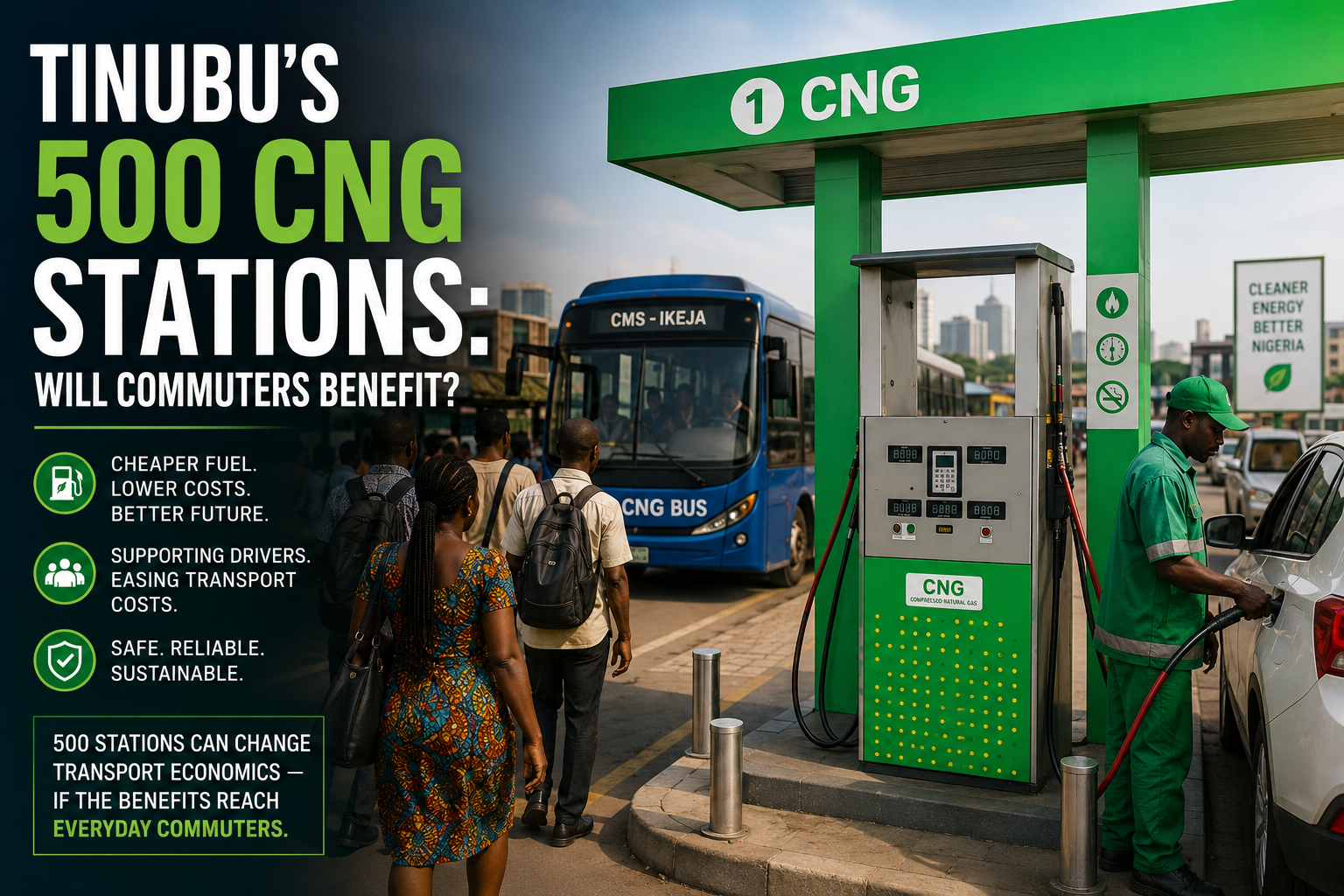
When petrol prices jump, the first place Nigerians feel it is not in policy speeches. It is at the bus stop.
A commuter in Lagos pays more for a danfo ride. A civil servant in Abuja watches taxi fares eat deeper into salary. A trader moving goods from Ibadan to Kano recalculates prices before the market even opens. That is the daily pressure behind Nigeria’s latest push for compressed natural gas, or CNG.
Following Channels Television’s report that President Bola Tinubu ordered an additional 500 CNG stations after the removal of petrol subsidy, the question is no longer whether Nigeria wants a fuel switch. It is whether the switch can move beyond announcements and finally reach the people who need relief most: everyday commuters.
CNG is not new in Nigeria. What is new is the urgency. Petrol subsidy removal in 2023 changed the economics of transport almost overnight. CNG offers a cheaper, locally available alternative. But cheaper fuel only matters when drivers can convert their vehicles safely, refill without wasting hours, and trust that the system will not expose them to risk.
Why 500 Stations Could Matter
Nigeria has long had the raw ingredient for a gas-powered transport transition: natural gas. The missing piece has been retail infrastructure.
A serious network of CNG stations could change transport economics in three ways.
First, it can reduce route anxiety. A taxi driver will not convert a petrol vehicle if there is only one CNG station across town. A bus operator will not risk a fleet conversion if refuelling depends on uncertain supply or long queues. Five hundred additional stations, if spread intelligently across commuter corridors, interstate routes and commercial hubs, would make CNG feel less experimental.
Second, it can lower operating costs for high-mileage vehicles. Commercial drivers are the natural first adopters because they burn fuel daily. A private car owner may take years to recover conversion costs. A taxi, ride-hailing car, school bus, logistics van or mass-transit bus can recover savings much faster if CNG is consistently cheaper than petrol.
Third, it can help stabilise fares. Transport fares do not fall automatically when fuel alternatives appear, but competition matters. If enough operators on busy routes run on lower-cost fuel, they gain room to offer cheaper fares or at least slow future fare hikes.

BYBIT.COM
Bybit — Trade crypto with up to $30,000 in welcome bonuses
Buy, sell and trade BTC, ETH and 1,000+ altcoins. Spot, futures and earn products on one of the world's fastest crypto exchanges.
Ad. Crypto trading involves risk. Terms apply — see the promotion page for details.
That is the promise. The danger is assuming stations alone will solve the problem.
The Conversion Cost Problem
For commuters to benefit, vehicles must first be converted. That is where the economics become difficult.
A proper CNG conversion is not just a new tank in the boot. It requires a cylinder, pressure regulator, fuel lines, valves, electronic controls, installation labour, calibration and safety checks. Costs vary by vehicle type, kit quality and cylinder size, but many commercial drivers still see conversion as a major upfront expense.
For a Lagos taxi driver, the choice is harsh: spend hundreds of thousands of naira now to save money later, or continue buying petrol daily because the immediate cash is not available. For a bus owner with multiple vehicles, the bill can become large enough to delay action entirely.
This is why public policy must focus on financing, not just infrastructure. Conversion vouchers, lease-to-own kits, cooperative financing through transport unions, bank-backed credit and employer-backed fleet conversion can decide whether CNG adoption becomes mass-market or remains a pilot scheme.
There is also a practical issue: downtime. A commercial vehicle that spends days in a workshop is losing income. Conversion centres must be numerous, trained and fast. If a driver has to travel far, wait in a queue, and lose several workdays, the promised savings become less attractive.
The best target is not every vehicle at once. Nigeria should start with the vehicles that move the most people and consume the most fuel: buses, taxis, ride-hailing cars, staff shuttles, delivery vans and government fleets. These are the vehicles where conversion savings can reach commuters fastest.
Stations Need More Than Signboards
A CNG station is not a petrol pump with a different label. It needs compressors, high-pressure storage, dispensers, gas supply, power and trained operators. If the station is connected to a gas pipeline, location becomes critical. If it relies on virtual pipelines — gas moved by truck in high-pressure cascades — logistics and maintenance become even more important.
That means the 500-station order must be judged by three questions.

TEMU.COM
Teclast P30T Android 16 Tablet — 10.1" TDDI Display, Unisoc T610 Octa-Core, 12GB RAM (3GB+9GB Virtual), 128GB ROM, 6000mAh
🔥 Flash grab price: ₦999 — high-priced item for next to nothing. Limited quantities, first come, first served.
Ad. Eligible new app users in Nigeria only. Shipping or other charges may apply. See the T&Cs on the promotion page.
Where will they be located? A station in an industrial estate may help fleet operators, but not necessarily a commuter corridor. Nigeria needs stations near motor parks, bus depots, airports, logistics clusters, university towns and interstate routes.
Who will operate them? Private investors can move faster than government agencies, but they need predictable rules, access to land, gas supply agreements and tariff clarity. Without bankable incentives, stations may cluster only in profitable urban areas while smaller cities are left behind.
How reliable will they be? Drivers will not trust CNG if pumps are frequently down, pressure is low, queues are long or payments are chaotic. The rollout has to include maintenance standards, spare parts supply and operator training from day one.
There are useful examples. In cities where fleet operators refuel at depots, CNG works better because vehicles return to predictable points. That model could fit BRT buses, airport taxis, corporate shuttles and state-owned transit schemes. For scattered private motorists, public station density must be much higher before adoption feels convenient.
Safety Will Make or Break Public Trust
CNG is widely used around the world, but it is a high-pressure fuel. That makes safety regulation non-negotiable.
Nigeria cannot afford a market flooded with substandard cylinders, roadside installations and unlicensed workshops. One major accident caused by poor conversion could damage public confidence for years. The public must know that a converted vehicle has been inspected, certified and fitted with approved equipment.
A credible safety system should include approved conversion centres, traceable cylinders, periodic inspection, pressure testing, installer certification and visible compliance stickers or digital records. Enforcement must cover both new conversions and imported used vehicles that may already carry old gas systems.
The regulator’s job is also to make standards understandable. Drivers should know where to convert, what documents to demand, how often cylinders must be inspected and what warning signs to watch for. Safety cannot be buried in technical manuals. It must be part of the public campaign.
This matters because CNG adoption depends on trust. A commuter entering a CNG bus should not wonder whether the cylinder was fitted by an expert or improvised by a mechanic trying to cut costs.

JUMIA.COM.NG
Jumia — Shop phones, electronics, fashion and more at up to 70% off
Nigeria's largest online marketplace. Daily deals, free delivery on selected items and pay on delivery.
Ad. Offers and pricing subject to availability on Jumia.
The Real Test: Lower Fares, Not Bigger Announcements
The success of Tinubu’s 500-station directive will not be measured by ribbon-cuttings. It will be measured at bus stops.
Can a driver convert without being trapped by debt? Can a bus refill quickly during normal operations? Can commuters see stable or lower fares on major routes? Can regulators prevent unsafe conversions before they become tragedies? Can rural and mid-sized cities avoid being excluded from the infrastructure map?
If the answer is yes, CNG could become one of the most practical responses to Nigeria’s post-subsidy transport crisis. It would not eliminate inflation, fix bad roads or replace broader energy reform. But it could reduce one of the biggest daily costs facing households.
If the answer is no, the country risks building islands of CNG access that serve a few fleets while millions of commuters keep paying petrol-driven fares.
Conclusion
Five hundred new CNG stations would be a major step. But stations are only one side of the transition. Nigeria also needs affordable conversions, trained technicians, reliable gas supply, enforceable safety standards and a rollout plan focused on the routes ordinary people use every day.
CNG can work. The next question is whether the policy will be built for headlines — or for commuters waiting at the bus stop on Monday morning.