Obi’s INEC Claim Raises 2027 Trust Stakes
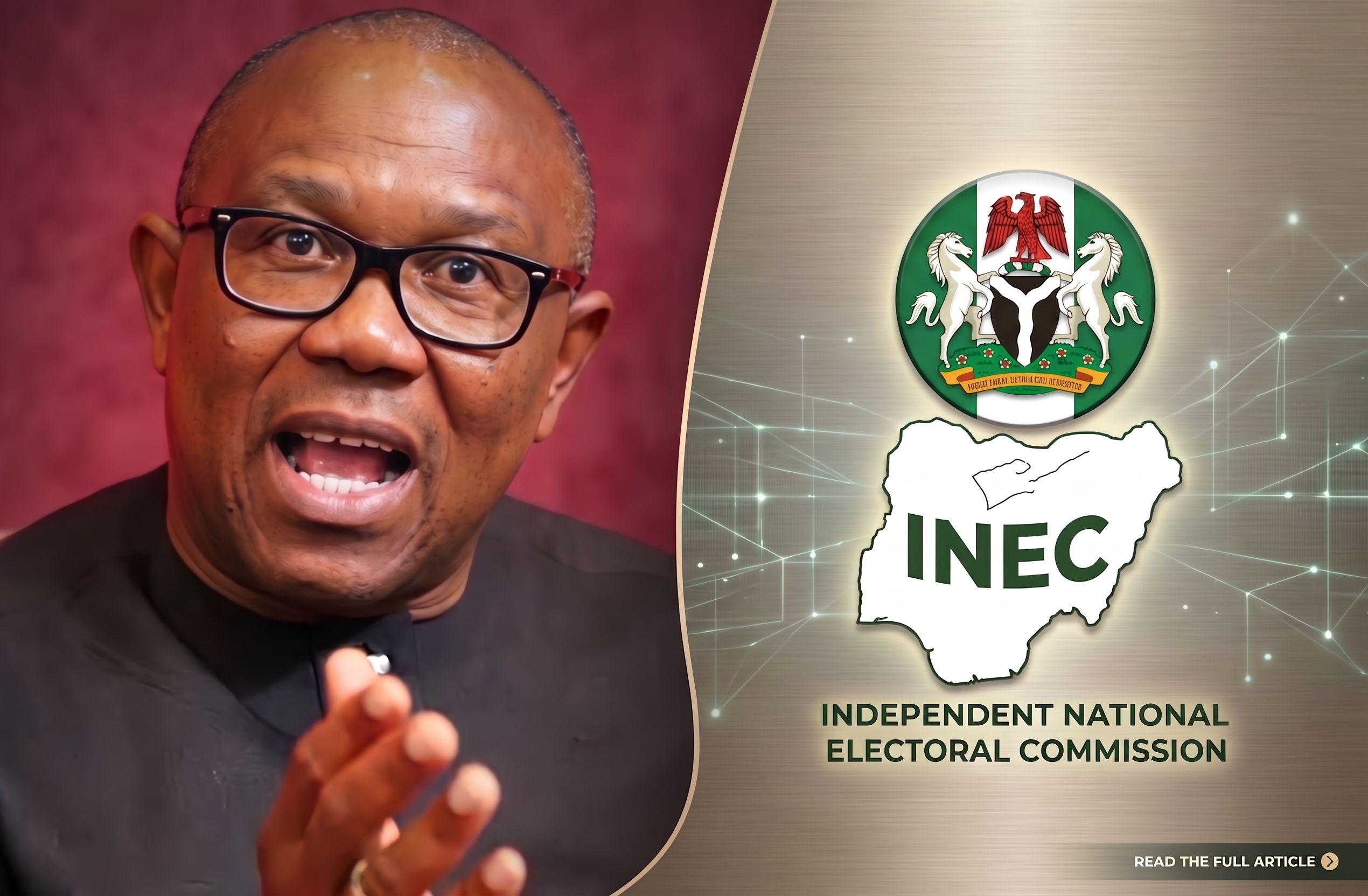
Peter Obi has put Nigeria’s next election argument on a sharper edge. His claim, amplified in major broadcast headlines, is explosive: that he has proof the chairman of the Independent National Electoral Commission, INEC, worked for a rival political camp during the disputed 2023 presidential election.
That allegation remains a claim, not an established fact. INEC and its chairman are entitled to a response, and any evidence Obi says he has must be tested in the open, not merely waved before an already polarised public. But politically, the damage is already larger than one soundbite. It lands in a country where millions of voters still remember the 2023 election through one question: why were polling-unit presidential results not uploaded in the transparent, immediate manner many expected?
That is why Obi’s allegation matters beyond Obi. It is likely to intensify the demand that, before 2027, Nigeria must settle the rules, technology, accountability and legal force behind polling-unit result transmission.
A Fresh Allegation in an Old Trust Crisis
The 2023 presidential election did not merely produce a winner and losers. It produced a legitimacy debate that has refused to disappear.
INEC had promoted technology as a confidence-builder: the Bimodal Voter Accreditation System, BVAS, for accreditation and the INEC Result Viewing portal, IReV, for public viewing of polling-unit result sheets. Many voters interpreted this as a promise that results from polling units would be visible quickly and would make manipulation harder as figures moved through ward, local government and state collation stages.
When presidential result uploads to IReV became slow and inconsistent on election day, while other election categories appeared to move differently, suspicion hardened. INEC cited technical problems. Opposition parties alleged a deeper failure. Courts later upheld the presidential result, but judicial closure did not equal public closure.
Obi’s new claim reopens that wound because it shifts the conversation from technical failure to institutional capture. If the problem was only technology, the answer is better systems. If voters believe the problem was partisan control, the answer becomes more radical: enforceable transparency, independent audits, stronger sanctions and a redesigned results-management chain.
That is the real political danger for INEC ahead of 2027. It is not only being asked to run an election. It is being asked to prove that its own centre can be trusted.
Why Polling-Unit Transmission Has Become the Battleground
The polling unit is where Nigerian elections are most visible and least abstract. Voters queue, accreditation happens, ballots are counted, party agents watch, results are entered on the official result sheet, and figures are announced. Once that sheet leaves the unit, trust begins to depend on paperwork, logistics and officials the average voter cannot see.
That is why reform advocates focus on the polling unit. If the official result sheet — commonly referred to in presidential elections as Form EC8A — is photographed and uploaded from the polling unit before onward movement, the public gains a reference point. Party agents, observers, journalists and citizens can compare what was announced locally with what later appears at collation.
Concrete examples are easy to imagine. If a polling unit in Anambra records 120 votes for Party A, 60 for Party B and 10 for Party C, that result should be publicly visible before it is swallowed by the collation pipeline. If a later ward result suggests that same unit delivered 300 votes for Party B, the discrepancy can be spotted quickly. If a result sheet is blurred, missing, unsigned or uploaded hours later from an unclear location, that too becomes part of the audit trail.
This is not a cure for every electoral abuse. Vote-buying, intimidation, underage voting, ballot snatching and compromised officials can happen before any upload. But transparent polling-unit transmission attacks a specific vulnerability: the suspicion that votes change between the polling unit and final declaration.
For 2027, that issue will not be a footnote. It may become the central test of electoral credibility.
The Legal Ambiguity INEC Must Resolve Before 2027
Nigeria’s Electoral Act 2022 gave INEC broad powers to prescribe procedures for voting, result transmission and collation. INEC’s own guidelines created expectations around technology and the publication of polling-unit results. But the 2023 dispute exposed a dangerous ambiguity: what, exactly, is mandatory, what is discretionary, and what happens when the technology fails?
That ambiguity benefits no one. It leaves parties free to claim betrayal, INEC free to argue operational discretion, and voters trapped between legal technicalities and democratic expectations.
Before 2027, INEC and lawmakers should not leave this to interpretation. Nigeria needs a clear, public results-transmission framework that answers basic questions:
- Must every polling-unit result sheet be uploaded before collation proceeds?
- What is the legally valid fallback if a device fails or there is no network?
- Who records the failure, and in what form?
- Can collation continue where polling-unit uploads are missing?
- What penalties apply to officials who deliberately fail to upload, upload the wrong sheet or obstruct party agents?
- Will parties and accredited observers receive structured access to the same polling-unit data?
These are not abstract technicalities. They are the difference between a system voters can interrogate and one they are asked simply to accept.
INEC’s Credibility Problem Is Now Bigger Than Technology
Even the best election technology cannot survive a credibility collapse. BVAS machines, upload portals and digital dashboards are only as trusted as the people who manage them.
That is why Obi’s allegation is so consequential. If he presents credible evidence, the institutional fallout could be severe. If he does not, the claim may still deepen distrust among supporters who already believe 2023 was mishandled. Either way, INEC cannot respond with silence, defensiveness or vague assurances.
The commission needs a 2027 trust plan, not a public relations plan. That means independent stress-testing of election technology before voting day. It means publishing clear incident logs when uploads fail. It means training ad hoc staff with procedures citizens can understand. It means inviting credible local and international observers to scrutinise the results-management system before, during and after the vote.
It also means communicating honestly. Nigerians do not expect technology to be perfect. They do expect failures to be explained in real time, documented properly and corrected transparently.
The lesson of 2023 is that silence creates its own election results. In the absence of timely clarity, rumour becomes evidence and suspicion becomes political identity.
What 2027 Will Test
The next presidential election will test more than party strength. It will test whether Nigeria has learned that electoral legitimacy is built at the smallest unit of democracy: the polling unit.
For the ruling party, a credible process is essential because victory without trust is politically expensive. For the opposition, transparency is the only way to turn grievance into democratic competition rather than permanent rejection. For INEC, 2027 is a chance to rebuild authority — but only if it accepts that confidence cannot be demanded after results are announced. It must be designed into the process before the first ballot is cast.
Obi’s claim has raised the temperature. The responsible response is not to treat it as just another partisan attack, nor to accept it untested. The responsible response is to force the larger question into the open: how will Nigeria ensure that polling-unit results are captured, transmitted, published and protected in a way citizens can verify?
Conclusion
Nigeria’s 2027 election will not begin on campaign launch day. It is already beginning in the battle over trust.
Peter Obi’s allegation against INEC’s leadership may or may not withstand scrutiny. But it has revived the central demand that emerged from 2023: no more opaque results management, no more avoidable uncertainty, and no more asking voters to trust what they cannot see.
If INEC wants 2027 to be accepted, the answer must start at the polling unit — with rules, technology and transparency strong enough to survive defeat, victory and suspicion alike.