Italy’s Infantino Snub Tests Europe’s FIFA Clout
Italy’s break with Gianni Infantino exposes Europe’s shrinking leverage in FIFA and the battle over football’s future.
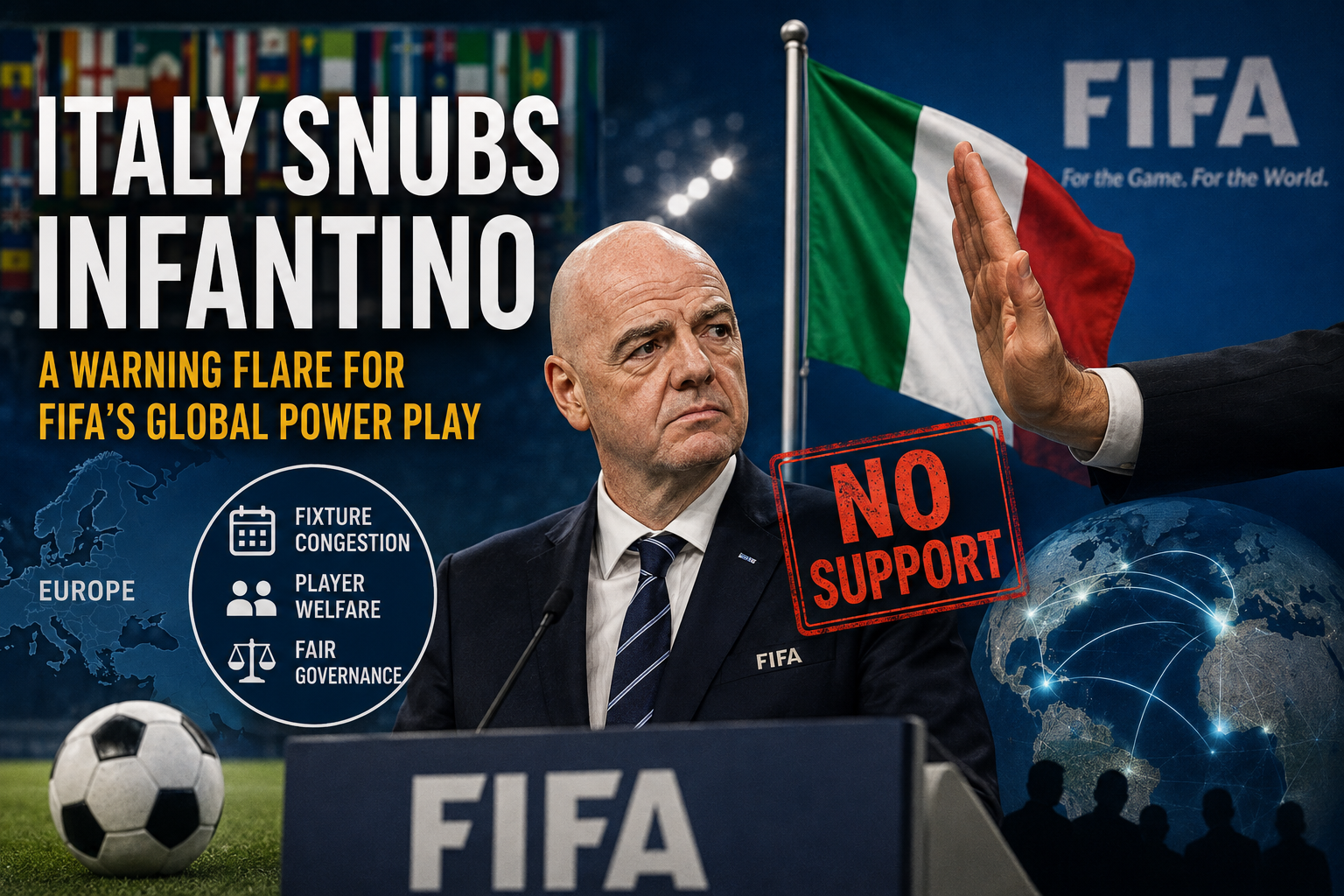
Italy’s decision to withdraw support for Gianni Infantino’s FIFA re-election bid is not merely a diplomatic slap from one of football’s great nations. It is a stress test for Europe’s influence in the sport it still largely bankrolls, watches, exports and mythologises.
For decades, Italy could assume that its voice carried institutional weight: four men’s World Cups, the prestige of Serie A, the political gravity of UEFA and a federation used to sitting near the centre of the game’s old order. But FIFA under Infantino has become something different: a global electoral machine built on expansion, redistribution and the votes of 211 member associations. In that system, European discomfort matters — but it no longer automatically decides.
That is why Italy’s snub is significant. It is a signal that frustration with FIFA’s direction is no longer confined to private UEFA corridors or player-union statements about fixture congestion. It has surfaced as open political resistance from a major European federation.
Why Italy’s Move Matters Beyond Italy
A single national association refusing to support a FIFA president does not topple a regime. Infantino was re-elected unopposed in 2023, and FIFA’s electoral structure gives equal voting power to San Marino and Brazil, Malta and Germany. The arithmetic of global football governance is deliberately broad, and Infantino has mastered it.
But Italy is not a marginal dissenter. Its withdrawal of support carries symbolic weight because it comes from inside the European establishment. It tells other federations that opposition can be aired publicly, not merely grumbled about privately. It also tests whether UEFA can turn shared unease into a coherent political position.
Europe’s complaint is not only about personality. It is about process. FIFA has pushed through major changes that reshape the football calendar: a 48-team men’s World Cup, an expanded 32-team Club World Cup, and a commercial strategy that places more FIFA-controlled events into already packed seasons. The logic from Zurich is straightforward: more countries involved, more money generated, more global reach. The concern from Europe is equally clear: more games, more strain on players, more conflict with domestic leagues and clubs.

BYBIT.COM
Bybit — Trade crypto with up to $30,000 in welcome bonuses
Buy, sell and trade BTC, ETH and 1,000+ altcoins. Spot, futures and earn products on one of the world's fastest crypto exchanges.
Ad. Crypto trading involves risk. Terms apply — see the promotion page for details.
Italy’s stance therefore becomes a proxy fight. Is FIFA a global development body with the right to expand opportunity? Or is it increasingly a competition organiser willing to squeeze the club game — especially the European club game — to fund its political majority?
Infantino’s Power Base Is Not in Milan or Madrid
Infantino’s strength has always been that he does not need unanimous European love. His presidency rests on a wider coalition across Africa, Asia, the Caribbean, Central America and smaller football nations that have benefited from FIFA Forward funding and the promise of greater inclusion.
That is not incidental; it is the core of his politics. The expansion of the World Cup from 32 to 48 teams was not just a sporting decision. It gave more associations a realistic path to the tournament, turning aspiration into political capital. For federations outside the traditional elite, Infantino can argue that he has delivered something Europe long resisted: access.
The same applies to FIFA’s development money. For a federation with limited infrastructure, a FIFA-funded training centre or administrative project is not an abstract governance line item. It is tangible proof that Zurich is paying attention. When votes are counted, that matters.
This is where Italy’s protest runs into structural reality. European federations may command the strongest leagues, the richest clubs and much of the commercial audience. But FIFA elections are not weighted by revenue, television ratings or Champions League pedigree. They are one association, one vote. Infantino’s genius — and his critics would say his most cynical skill — has been understanding that the emotional centre of football is not the same as the electoral centre of FIFA.
The Calendar War Is the Real Battlefield
The most combustible issue is not the next FIFA election. It is the calendar.

TEMU.COM
Teclast P30T Android 16 Tablet — 10.1" TDDI Display, Unisoc T610 Octa-Core, 12GB RAM (3GB+9GB Virtual), 128GB ROM, 6000mAh
🔥 Flash grab price: ₦999 — high-priced item for next to nothing. Limited quantities, first come, first served.
Ad. Eligible new app users in Nigeria only. Shipping or other charges may apply. See the T&Cs on the promotion page.
European clubs already complain that elite players are being pushed beyond reasonable limits. A modern star can move from domestic league to domestic cup, European competition, international qualifiers, Nations League fixtures, summer tournaments, pre-season tours and now expanded FIFA events. The margins for rest are shrinking.
Concrete examples are everywhere. The Champions League has expanded. The Club World Cup is being turned into a major summer tournament. The men’s World Cup has grown to 48 teams from 2026. FIFA has floated and defended ideas that would increase the frequency or scale of its competitions, while leagues and unions warn about player welfare and commercial saturation.
Italy has lived the contradictions. Serie A wants global growth and foreign broadcast relevance, yet its clubs depend on players who are already stretched. The national team needs international competition to rebuild prestige after missing recent World Cups, yet the domestic system worries about burnout and scheduling chaos. Italian football wants a powerful FIFA when it protects the global game — and a restrained FIFA when Zurich’s ambitions collide with European interests.
That tension explains the political bite of the Infantino snub. Italy is not rejecting global football. It is challenging the terms on which global football is being expanded.
Europe’s Problem: Grievance Is Not Strategy
The danger for UEFA and its leading members is that opposition to Infantino becomes more theatrical than effective. Public disapproval can create headlines, but FIFA politics rewards coalition-building. If Europe wants to restrain Infantino, it must do more than complain about fixture congestion or governance style. It needs a persuasive alternative for the rest of the world.
That is difficult. Many non-European federations hear Europe’s warnings about too many games and suspect self-interest. They see the Premier League, La Liga, Serie A and the Champions League generating enormous wealth, then bristle when Europe lectures FIFA about commercial expansion. To them, Europe’s argument can sound like: our competitions are sacred; yours are excessive.

JUMIA.COM.NG
Jumia — Shop phones, electronics, fashion and more at up to 70% off
Nigeria's largest online marketplace. Daily deals, free delivery on selected items and pay on delivery.
Ad. Offers and pricing subject to availability on Jumia.
Infantino exploits that perception. He positions FIFA as the institution that opens doors to countries outside the old elite. When Europe pushes back, he can frame it as protectionism. That message lands in places where football’s biggest stages have historically felt distant.
So Italy’s stand matters only if it becomes part of a larger, smarter European case: one that links player welfare, transparent governance, credible consultation and fair revenue distribution without sounding like a defence of the status quo. Europe cannot win this argument by nostalgia. It has to show that a healthier football calendar benefits Lagos, Lima and Ljubljana as much as London or Milan.
A Snub That Reveals the Shape of the Game
Italy’s withdrawal of support is unlikely to be the final word on Infantino’s future. But it is an unusually clear glimpse of the struggle defining modern football governance.
On one side is FIFA’s expansionist model: more tournaments, more participants, more global voting strength. On the other is a European bloc that still supplies much of the game’s money and talent but is discovering that influence is no longer automatic.
That is the real story. Italy’s snub is less a palace coup than a warning flare. The old powers can still make noise. The question is whether they can still build power.