China-Linked Hacks Put U.S. Cyber Defense on Alert
A reported disruption of China-linked hacking renews scrutiny of U.S. cyber defenses, federal targets and critical infrastructure risk.
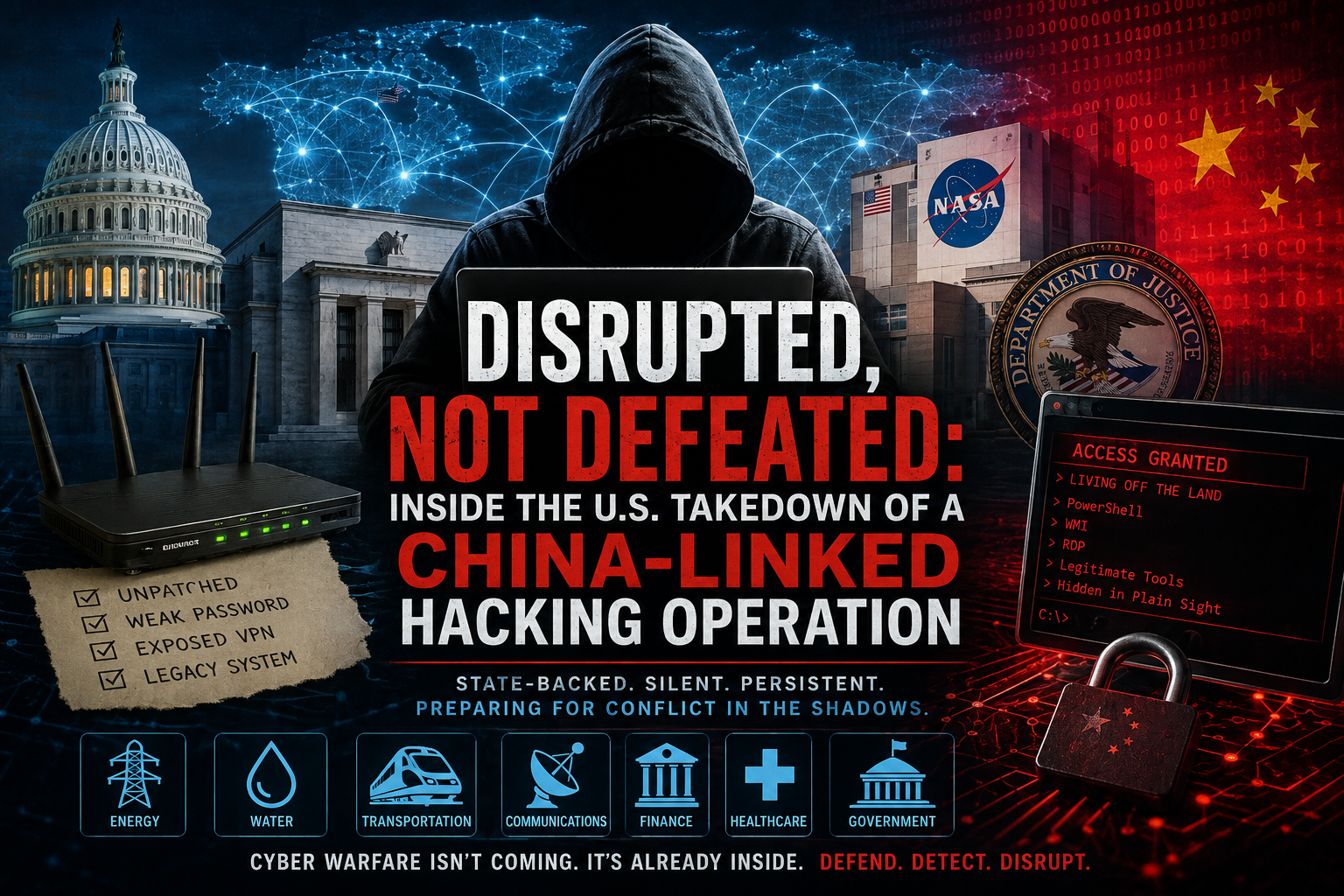
The most important cyber battles rarely look like a blinking red map in a war room. More often, they look like an aging home router, a forgotten VPN appliance, or a perfectly legitimate administrator command run at the wrong time by the wrong actor.
That is why a reported U.S. disruption of a China-linked hacking operation — one said to have included interest in heavyweight federal targets such as NASA, the Federal Reserve and the Justice Department — has landed with such force in Washington’s cybersecurity circles. The immediate story is about a takedown. The bigger story is about how state-backed hackers are preparing for conflicts that may begin not with missiles, but with access.
U.S. officials have spent the past year warning that Chinese state-sponsored groups are not merely stealing data. They are positioning themselves inside networks tied to communications, transportation, water, energy and government operations. If those warnings are correct, the goal is not just espionage. It is leverage.
The takedown is not the end of the story
The Justice Department has previously described court-authorized operations to disrupt botnets used by China-linked hackers, including networks of compromised small-office and home-office routers. These devices are attractive because they are everywhere, poorly monitored and often sit outside the security perimeter of large institutions. A hacker who routes traffic through thousands of ordinary-looking devices can make malicious activity harder to trace and easier to blend into normal internet noise.
That matters because a disruption can remove a tool without removing the strategic problem. Taking down malware on infected routers is useful. It can burn infrastructure, interrupt access and force an adversary to rebuild. But it does not change the incentives driving state-backed cyber operations: persistent access, deniability and the ability to impose costs during a crisis.
The reported focus on agencies and institutions like NASA, the Fed and Justice underscores the breadth of the target set. These are not interchangeable bureaucracies. NASA sits at the intersection of aerospace research, defense-adjacent technology, contractors and universities. The Federal Reserve is central to financial stability and payments confidence. The Justice Department holds investigative, legal and national security equities that are valuable to any foreign intelligence service.
In other words, the target list is a map of American power.

BYBIT.COM
Bybit — Trade crypto with up to $30,000 in welcome bonuses
Buy, sell and trade BTC, ETH and 1,000+ altcoins. Spot, futures and earn products on one of the world's fastest crypto exchanges.
Ad. Crypto trading involves risk. Terms apply — see the promotion page for details.
Why China-linked campaigns are so difficult to stop
Modern state-backed hacking does not always rely on loud malware or obvious data theft. U.S. agencies and Microsoft have repeatedly warned about “living off the land” tactics, where intruders use legitimate tools already present in a network: PowerShell, Windows Management Instrumentation, remote desktop services, valid credentials and administrative utilities.
That approach flips traditional defense on its head. Antivirus tools are designed to spot suspicious software. But what happens when the suspicious activity is performed with trusted software by an account that appears valid?
This is one reason groups such as Volt Typhoon have become a focus of U.S. warnings. The concern is not only that intruders can enter a network; it is that they can remain there quietly, mapping systems and preparing options. In a peacetime espionage campaign, that access may be used to collect intelligence. In a geopolitical crisis, the same foothold could be used to disrupt communications, slow logistics, affect emergency services or undermine public confidence.
The technical entry points are often mundane: unpatched edge devices, misconfigured remote access, stolen credentials, weak multifactor authentication, legacy systems and third-party suppliers. The strategic consequences are not mundane at all.
Federal targets are part of a wider infrastructure problem
It is tempting to see “NASA,” “the Fed” and “Justice” as a federal cybersecurity story. They are. But the larger risk is that government networks do not operate in isolation. They depend on contractors, cloud services, universities, telecom carriers, software vendors and local infrastructure.
A space agency’s research ecosystem includes laboratories, aerospace manufacturers and academic partners. A financial regulator depends on communications networks, data providers and payment infrastructure. A law enforcement agency relies on state and local partners, court systems, case management tools and private-sector reporting.
That creates a sprawling attack surface. A hacker does not always need to breach the front door of a hardened federal agency if a contractor’s remote access system, a supplier’s software update process or an unmanaged router offers a side entrance.

TEMU.COM
Teclast P30T Android 16 Tablet — 10.1" TDDI Display, Unisoc T610 Octa-Core, 12GB RAM (3GB+9GB Virtual), 128GB ROM, 6000mAh
🔥 Flash grab price: ₦999 — high-priced item for next to nothing. Limited quantities, first come, first served.
Ad. Eligible new app users in Nigeria only. Shipping or other charges may apply. See the T&Cs on the promotion page.
The same logic applies to critical infrastructure. Water utilities, ports, hospitals and energy providers often operate with tight budgets, aging operational technology and a patchwork of vendors. Many industrial systems were built for reliability and uptime, not internet-exposed threat environments. When those systems become connected to corporate IT networks, the boundary between data theft and physical disruption becomes dangerously thin.
This is why U.S. cyber strategy has shifted from treating intrusions as isolated incidents to treating them as indicators of systemic risk.
What stronger defense looks like now
The playbook is not mysterious, but it is hard to execute at national scale.
First, agencies and critical infrastructure operators need visibility. You cannot defend what you cannot see. That means centralized logging, endpoint detection, asset inventories and monitoring of edge devices such as VPNs, firewalls and routers. Too many compromises begin in the gaps between what an organization owns and what it actually tracks.
Second, identity has become the new perimeter. Phishing-resistant multifactor authentication, least-privilege access and rapid credential rotation are no longer best practices reserved for elite organizations. They are baseline controls. If an attacker’s preferred method is to look like a legitimate user, defenders need better ways to challenge and limit that user.
Third, segmentation matters. A compromise in an office network should not provide a straight path to operational systems, sensitive research or privileged administrative consoles. Well-designed segmentation can turn a breach from a crisis into a contained incident.
Fourth, the burden cannot fall only on victims. Technology vendors must ship products that are secure by default, easier to patch and less dependent on customers discovering dangerous configurations after deployment. Federal “secure by design” pressure is partly about changing the market: fewer default passwords, clearer logging, safer update mechanisms and longer support for widely used devices.

JUMIA.COM.NG
Jumia — Shop phones, electronics, fashion and more at up to 70% off
Nigeria's largest online marketplace. Daily deals, free delivery on selected items and pay on delivery.
Ad. Offers and pricing subject to availability on Jumia.
Finally, disruption has to be paired with resilience. Botnet takedowns, sanctions and indictments can raise costs for adversaries. But the United States also needs organizations that can operate through an intrusion, restore quickly and communicate clearly when systems are under pressure.
The next cyber crisis may already be staged
The most sobering lesson from recent China-linked cyber warnings is that access can be planted long before it is used. A router compromised today may be a relay point tomorrow. A dormant account may become a crisis tool months from now. A quiet scan of a utility network may be preparation, not curiosity.
That does not mean every intrusion is a prelude to disaster. It does mean the old model — clean up after the breach, publish a report, move on — is no longer enough.
The reported disruption of a Chinese hacking operation is a reminder that U.S. cyber defense is now a contest of persistence. Washington can knock adversaries off infrastructure, but it must also reduce the number of places they can hide. In the next conflict, the decisive move may not be the first shot. It may be the access gained years earlier, waiting in plain sight.
Sources
- Justice Department: U.S. Government Disrupts Botnet Used to Conceal Hacking of Critical Infrastructure
- CISA Advisory AA24-038A: PRC State-Sponsored Actors Compromise U.S. Critical Infrastructure
- Microsoft: Volt Typhoon targets U.S. critical infrastructure with living-off-the-land techniques
- FBI: Chinese Government Hackers Target U.S. Critical Infrastructure