Can MTF’s Masterclasses Close Nollywood’s Skills Gap?
MultiChoice Talent Factory’s 13 new masterclasses spotlight Nollywood’s urgent skills gap—and why private pipelines may rival film schools.
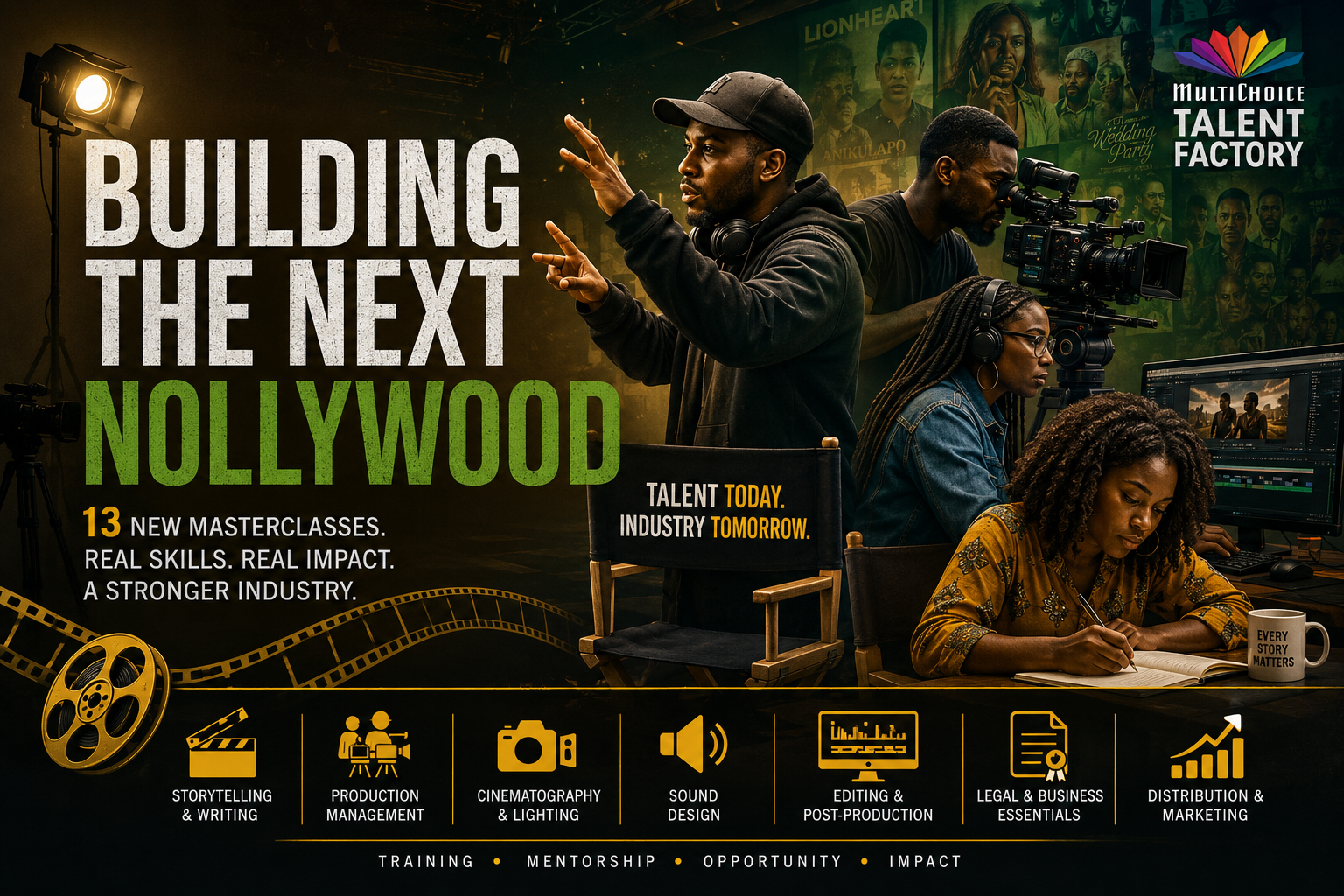
Nollywood does not have a talent problem. It has a finishing problem.
Every year, Nigeria produces thousands of ambitious actors, writers, directors, editors, cinematographers and producers hungry for a shot. The issue is what happens between raw talent and a professional set: who teaches continuity, budgeting, showrunning, post-production discipline, sound design, legal basics, pitching, safety, distribution strategy and the brutal art of delivering on schedule?
That is why the latest move by MultiChoice Talent Factory matters. As the initiative marks eight years, its unveiling of 13 new masterclasses for Nigeria’s creative industry arrives at a revealing moment. Nollywood is bigger, louder and more global than it has ever been, but its skills pipeline is under pressure. The question is no longer whether Nigeria has stories to tell. It is whether the industry can train enough people to tell them at the technical standard demanded by streamers, cinemas, broadcasters and increasingly impatient audiences.
Why 13 Masterclasses Matter Now
Masterclasses can sound like soft corporate language: a polished panel, a few photo ops, a certificate, then everyone goes home. But in Nollywood’s current phase, targeted short-form training may be more consequential than it looks.
The industry has moved beyond the era when speed alone was the competitive advantage. Yes, the old direct-to-video ecosystem built Nollywood’s muscle memory: low budgets, fast turnarounds, improvisational problem-solving and relentless output. But the new marketplace is different. A filmmaker pitching to Africa Magic, Showmax, Prime Video-style platforms, YouTube-first distributors or cinema chains needs more than hustle. They need chain-of-title discipline, deliverables, audience data, writers’ rooms, post-production workflows and production accounting.
That is where masterclasses can plug practical gaps. A focused session on story development can sharpen weak scripts before cameras roll. A class on line producing can save a production from collapsing midway. Training on sound can address one of Nollywood’s most persistent viewer complaints. A session on directing actors for screen can help reduce the overacting that still haunts some low-budget releases. None of this replaces deep education, but it addresses what many working creatives need most: usable skills they can apply on the next job.
MultiChoice has a direct stake in this. Its ecosystem depends on a steady supply of watchable local content—daily soaps, original dramas, reality formats, telenovelas, prestige series, magazine shows and films. If the talent pool improves, the pipeline improves. That makes the Talent Factory both a training initiative and a strategic investment in the company’s own content future.

BYBIT.COM
Bybit — Trade crypto with up to $30,000 in welcome bonuses
Buy, sell and trade BTC, ETH and 1,000+ altcoins. Spot, futures and earn products on one of the world's fastest crypto exchanges.
Ad. Crypto trading involves risk. Terms apply — see the promotion page for details.
The Film School Question
The sharper debate is whether private training pipelines are becoming more important than formal film schools in Nollywood.
Nigeria has universities, polytechnics and private institutions offering theatre arts, mass communication, film, media and creative production courses. They matter. They teach history, theory, criticism, research, aesthetics and the broader language of culture. A healthy screen industry needs that foundation.
But film schools often struggle with three problems: outdated equipment, limited industry access and curricula that move slower than the market. A student may graduate knowing the theory of mise-en-scène but not how to create a delivery schedule for a 260-episode telenovela. They may understand editing principles but not the workflow expectations of a modern post house. They may write an excellent academic paper on Nigerian cinema but never sit in a writers’ room where a showrunner has to break 13 episodes before production starts.
Private pipelines, by contrast, tend to be closer to the work. MultiChoice Talent Factory’s model has historically leaned on industry-facing training, mentorship, internships and exposure to the production environment. The value is proximity: learners encounter the pressures, vocabulary and compromises of actual content-making.
That does not mean private training should replace film schools. It means the old hierarchy is breaking. The future may belong to hybrid creatives: people with academic grounding, platform-specific training, apprenticeship experience and the ability to keep learning as technology changes.
Nollywood’s Skills Gap Is Not Just Technical
When people talk about Nollywood’s skills gap, they often focus on cameras, lighting and sound. Those are real issues, but the deeper gap is managerial.
Nollywood needs more producers who can build sustainable budgets and protect crews from chaos. It needs assistant directors who understand time, safety and call sheets. It needs production designers who can stretch limited resources without making every living room look like the same rented Lekki apartment. It needs script supervisors who catch continuity errors before Twitter does. It needs entertainment lawyers who can protect writers and producers. It needs data-literate executives who understand what audiences actually finish watching.

TEMU.COM
Teclast P30T Android 16 Tablet — 10.1" TDDI Display, Unisoc T610 Octa-Core, 12GB RAM (3GB+9GB Virtual), 128GB ROM, 6000mAh
🔥 Flash grab price: ₦999 — high-priced item for next to nothing. Limited quantities, first come, first served.
Ad. Eligible new app users in Nigeria only. Shipping or other charges may apply. See the T&Cs on the promotion page.
This is where the masterclass format can be powerful if it is specific enough. A generic “how to succeed in film” session will not move the needle. But a class on negotiating music rights for film? Valuable. A workshop on building a pitch deck for a limited series? Useful. A session on post-production delivery standards? Urgent. A conversation with a working showrunner about managing writers, directors and broadcaster notes? Gold.
The globalisation of African screen content has raised expectations. UNESCO’s work on the African film industry has repeatedly pointed to training, financing, distribution and infrastructure as key growth challenges. Nigeria is already one of the continent’s most visible screen markets, but visibility can become a burden when the world is watching and the production system remains uneven.
The Private Pipeline Advantage—and Its Risk
The strongest argument for private training pipelines is speed. Companies like MultiChoice can identify market gaps and respond quickly. If local drama output needs stronger writers, train writers. If production quality is slipping, train crew. If the business side is weak, create sessions on pitching, contracts and monetisation.
There is also the network effect. For a young filmmaker, being in the right room can be as important as learning the right concept. A masterclass attached to a major platform can connect participants to commissioning editors, producers, directors and peers. Nollywood has always run on relationships; structured access can make those relationships less accidental.
But there is a risk. If private platforms become the dominant trainers, they may shape the industry too narrowly around their own content needs. The danger is not conspiracy; it is gravity. Training linked to broadcasters and streamers may prioritise formats that serve platform schedules—soaps, serials, reality shows, middle-of-the-road dramas—while more experimental cinema, documentary and independent storytelling receive less attention.
That is why the best version of the MultiChoice Talent Factory is not just a feeder system. It should be an industry resource: one that raises standards even for creatives who later work with competitors, independent producers or global partners. A stronger Nollywood benefits everyone, including the companies that compete inside it.
What Success Should Look Like
The real test of these 13 masterclasses will not be attendance. It will be evidence.

JUMIA.COM.NG
Jumia — Shop phones, electronics, fashion and more at up to 70% off
Nigeria's largest online marketplace. Daily deals, free delivery on selected items and pay on delivery.
Ad. Offers and pricing subject to availability on Jumia.
Do participants get hired? Do their films and series improve? Do productions become better managed? Are more women and underrepresented voices entering technical roles? Are regional storytellers outside Lagos able to access the training? Are there follow-up labs, mentorships, apprenticeships or placements after the sessions end?
Nollywood does not need more ceremonial training. It needs ladders: clear routes from interest to competence, from competence to employment, and from employment to leadership. Masterclasses are useful when they become entry points into those ladders.
MultiChoice Talent Factory at eight sits in an interesting position. It is old enough to be judged by impact, but young enough to evolve. The 13 new masterclasses could be another round of industry goodwill—or they could be a practical response to the gap between Nollywood’s ambition and its workforce capacity.
The opportunity is obvious. Nigeria’s stories are travelling. The audience is expanding. The money is more complicated, but the appetite is real. What the industry needs now is not simply more content. It needs better-trained people at every stage of the chain.
If these masterclasses help turn raw hustle into repeatable craft, they will do more than fill a calendar. They will help build the next Nollywood.