Asuquo’s Silver, Super Falcons’ Hunt: Nigeria’s Moment
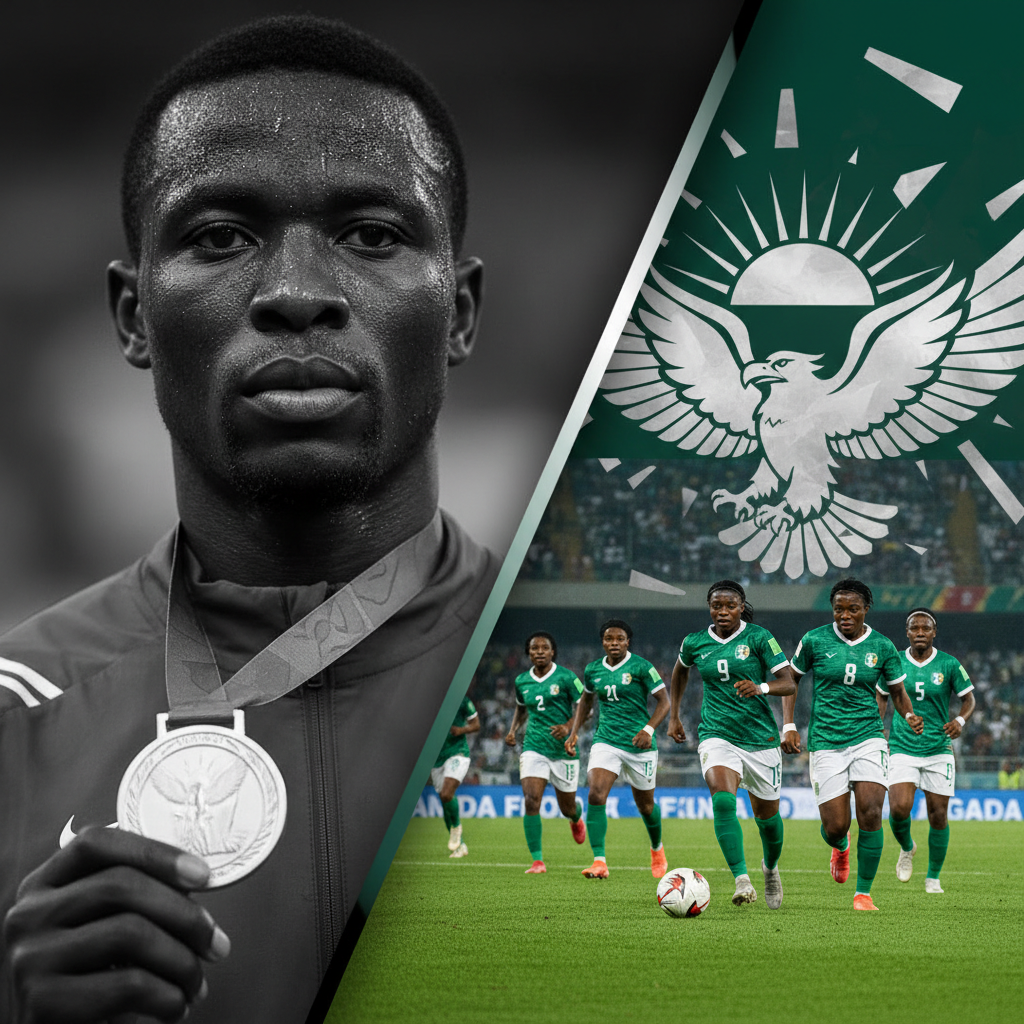
A silver medal can be quiet for only so long. When Asuquo stood on the Glasgow 2026 podium, Nigeria did not merely add another line to a medal table; it gained a fresh reminder that its women athletes are no longer waiting for permission to define the country’s sporting mood.
That is the bigger story behind this moment. In weightlifting, a Nigerian woman has again turned discipline, pain and repetition into international proof. In football, the Super Falcons remain locked into a title chase that carries history, pressure and expectation. Around them, WAFU competitions keep pushing club and youth talent into sharper view. Across codes, the pattern is unmistakable: Nigerian women are producing headline performances faster than the system is learning how to celebrate, protect and market them.
Asuquo’s silver is part of a bigger lifting culture
Weightlifting has often been one of Nigeria’s most reliable Commonwealth Games routes to the podium, and women have been central to that reputation. Asuquo’s Glasgow 2026 silver did not come from nowhere. It sits inside a line of performances that includes Adijat Olarinoye and Rafiatu Lawal winning gold at Birmingham 2022, with Lawal setting Commonwealth Games records in the women’s 59kg class.
That matters because weightlifting is not a sport of accidental success. It requires years of technical coaching, nutrition management, recovery, travel support and competition exposure. One missed detail can be the difference between a national record and a failed lift. For a Nigerian athlete to reach a Glasgow podium, she has already beaten the visible opponent and a long list of invisible ones: limited facilities, uneven funding, patchy media interest and the pressure of carrying a federation’s medal hopes.
Asuquo’s silver is therefore not just a personal achievement. It is evidence of a functioning pipeline, however imperfect. It proves that Nigerian women can keep converting raw strength into elite results when given even a workable competitive structure. The question is why that structure still feels like a fight rather than a guarantee.
The Super Falcons still set the national standard
If weightlifting is where Nigerian women often deliver medals without noise, football is where they carry the loudest national expectations. The Super Falcons are not treated as hopeful outsiders on the continent; they are treated as the team everyone measures against. With a record haul of Women’s Africa Cup of Nations titles, they have built a dynasty that makes every tournament feel like either a coronation or a crisis.
Their recent global performances have only sharpened that profile. At the 2023 FIFA Women’s World Cup, Nigeria drew with Olympic champions Canada, beat co-hosts Australia 3-2 in one of the tournament’s great group-stage statements, and then pushed England to penalties in the round of 16. Chiamaka Nnadozie’s command in goal, Rasheedat Ajibade’s leadership, Michelle Alozie’s relentless running and the attacking presence of Asisat Oshoala and Uchenna Kanu gave the world a fuller picture of the team: athletic, organized, stubborn and unafraid of bigger budgets.
That is why the current title hunt carries more than the usual tournament tension. The Falcons are chasing silverware, yes, but they are also defending the idea that Nigerian women’s football remains the continent’s reference point. Every WAFCON campaign becomes a referendum on standards: Are the domestic structures strong enough? Are players being prepared properly? Is the federation matching the ambition of the athletes?
The team’s answer on the pitch has usually been clearer than the country’s answer off it.
WAFU is turning promise into pressure
The renewed WAFU headlines around Nigerian women’s football are not a side story. They are the development engine. West African competitions expose players and clubs to the kind of knockout pressure that cannot be simulated in training. They also give domestic champions a bridge to the CAF Women’s Champions League, where the gap between local dominance and continental relevance is tested quickly.
Nigeria has already seen what that bridge can do. Bayelsa Queens used the WAFU-B route to reach the CAF Women’s Champions League and went on to finish third in Africa in 2022. Edo Queens later carried the NWFL flag into the same continental conversation, reinforcing the point that Nigeria’s club game has talent capable of travelling beyond familiar grounds.
This is where the Falcons’ future is being formed. Not every national-team player will be made abroad. Some will come through local clubs that need better pitches, stronger broadcasting, more medical support and regular competitive calendars. WAFU tournaments help reveal who is ready for the next jump. They also expose how much more serious investment is needed if Nigeria wants its women’s teams to dominate by design rather than by survival instinct.
Visibility is still the opponent nobody can ignore
The paradox is painful: Nigerian women are producing some of the country’s most consistent sporting value, yet they still have to campaign for attention after delivering results.
Weightlifting medals often trend briefly and then disappear from the national conversation. Domestic women’s football can still be difficult to watch consistently. Sponsorship deals remain thinner than the talent pool deserves. Athletes are too often celebrated in ceremonial language rather than supported through serious commercial planning.
Visibility is not vanity. It affects income, recruitment, sponsorship, fan culture and political pressure. A young girl who sees Asuquo on television, reads about Nnadozie in a major feature, or watches Edo Queens in a properly packaged broadcast is not just consuming sport. She is receiving evidence that there is a pathway.
The men’s game has long benefited from repetition: weekly coverage, transfer gossip, punditry, debate, outrage and analysis. Women’s sport needs the same oxygen. Not pity. Not novelty. Infrastructure.
That means federations publishing clear calendars. Broadcasters treating women’s competitions as inventory, not charity. Brands building long-term campaigns around athletes before medals arrive, not only after. Schools and state sports councils linking grassroots girls’ programmes to elite pathways. Journalists learning the names, records and tactical details with the same seriousness applied elsewhere.
Conclusion: turn this moment into a market
Asuquo’s Glasgow silver and the Super Falcons’ title chase belong to different arenas, but they are telling the same story. Nigerian women are carrying momentum across sports, from the platform to the penalty area, from WAFU qualifiers to continental finals.
The moment is real. The performances are real. What must change is the ecosystem around them. Nigeria does not lack women athletes worth watching. It lacks the habit of watching them properly, investing early and staying interested between podiums. If that changes, this will not be remembered as a moment. It will become a movement.