Africa’s Rating Agency Takes Aim at the Big Three
The AU’s planned October credit-rating launch could challenge how African debt is judged—but credibility will decide its power.
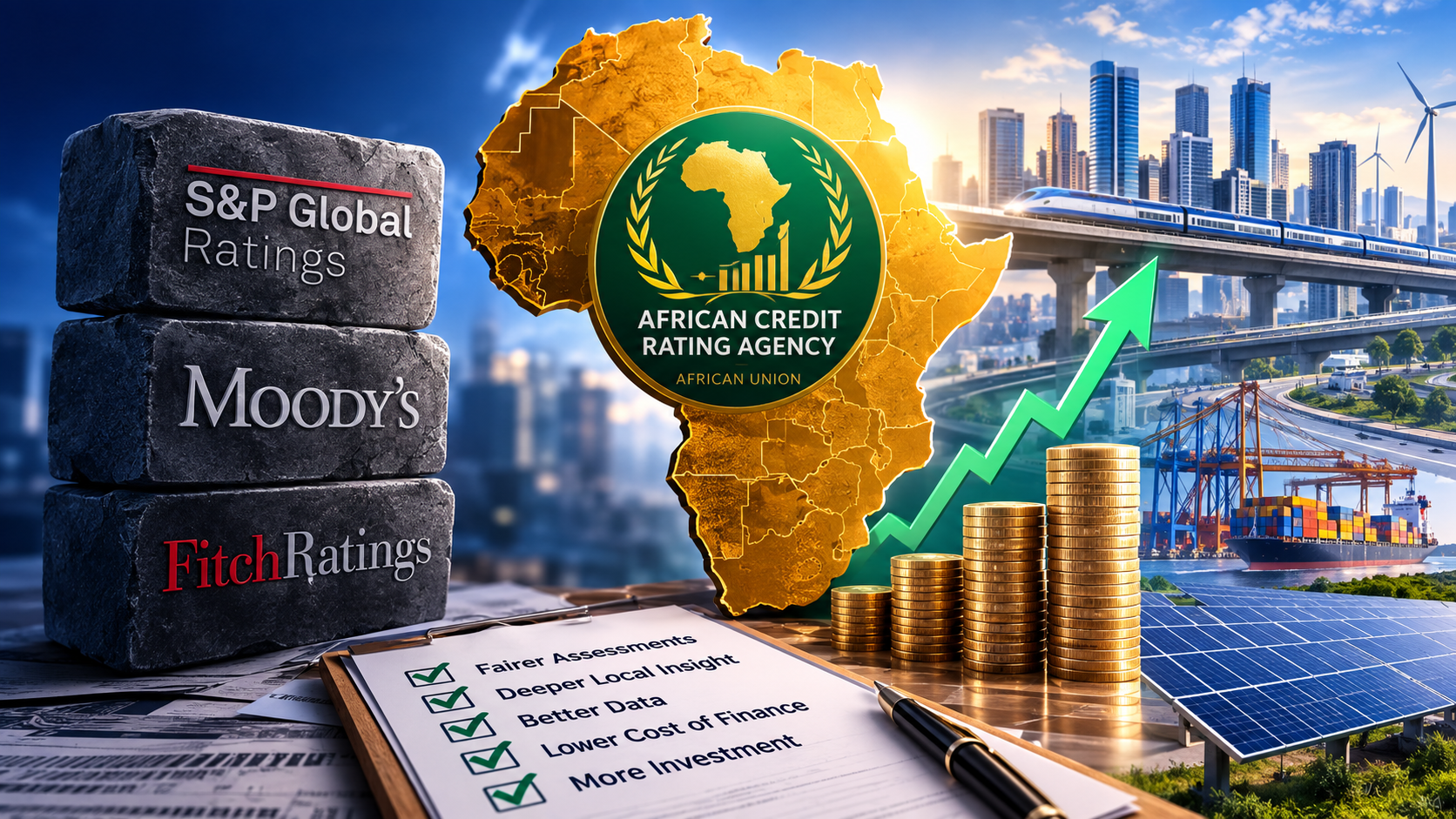
A credit rating can move billions before a finance minister has even finished a sentence. One notch down, and a country’s borrowing costs can jump. Two notches, and some investors are forced to sell. For African governments trying to finance power grids, roads, ports, schools, and climate resilience, the opinion of a handful of agencies in New York and London can shape the price of development.
That is why the African Union’s planned October launch of a homegrown credit rating agency is more than an institutional milestone. It is a direct challenge to the global market power of S&P Global Ratings, Moody’s, and Fitch—the “Big Three” that dominate sovereign and corporate ratings worldwide.
The question is not whether Africa can create a rating agency. It can. The question is whether markets will believe it.
Why Africa Wants Its Own Rating Voice
African policymakers have complained for years that global ratings often fail to capture the continent’s economic context: informal-sector resilience, local-currency revenue dynamics, multilateral support, commodity cycles, diaspora flows, and the political economy of reform. The criticism is not that African borrowers should get softer treatment. It is that they should get more accurate treatment.
The stakes are high. A sovereign rating influences the yield investors demand on Eurobonds, the borrowing costs of state-owned enterprises, and the pricing of private-sector debt. When a government is downgraded, domestic banks that hold sovereign bonds can also feel the hit. The rating becomes a signal that spreads through the financial system.
Ghana offers a clear example. As its debt crisis deepened, downgrades by major agencies accelerated its slide out of conventional market access before its eventual restructuring. Zambia’s 2020 default also showed how quickly distressed ratings can narrow a government’s funding options. Kenya, Nigeria, Egypt, and South Africa have all seen ratings pressure translate into higher risk premiums at moments when fiscal space was already tight.
This is the environment in which the AU-backed project is arriving. Reuters reported that the African Union has been working toward a continental ratings agency intended to provide alternative assessments of African sovereigns and corporates. The African Peer Review Mechanism has also pushed the idea through feasibility work, arguing that Africa needs a more balanced assessment architecture rather than total dependence on external agencies.
The Big Three’s Grip Is Hard to Break
The Big Three did not become powerful simply because they publish opinions. They are embedded in the plumbing of global finance.
Bond mandates, bank capital rules, insurance portfolios, pension-fund policies, and index eligibility criteria often reference ratings from recognized agencies. A rating from S&P, Moody’s, or Fitch can determine whether a bond is investment grade, whether a fund can hold it, and how much capital a bank must set aside against it. That gives their assessments legal and mechanical force beyond the research note itself.

BYBIT.COM
Bybit — Trade crypto with up to $30,000 in welcome bonuses
Buy, sell and trade BTC, ETH and 1,000+ altcoins. Spot, futures and earn products on one of the world's fastest crypto exchanges.
Ad. Crypto trading involves risk. Terms apply — see the promotion page for details.
A new African agency will therefore face a brutal credibility test. Investors will ask: Is its methodology transparent? Are its analysts independent? Who pays for the ratings? Can governments pressure it? Will it publish downgrades when politically inconvenient? Does it have access to reliable data? Will regulators recognize it?
Those questions matter because a rating agency that is seen as a policy instrument will not change market pricing. If investors suspect it exists to produce friendlier scores, they will discount its work immediately. If, however, it builds a track record of disciplined calls—upgrades when warranted, downgrades when necessary—it could become a serious second opinion.
That distinction is crucial. The agency does not need to replace the Big Three on day one. It needs to become credible enough that African issuers, local regulators, and global investors cannot ignore it.
What a Homegrown Agency Could Do Differently
The best argument for an African credit rating agency is not nationalism. It is information quality.
A continent-based agency could develop deeper local datasets, hire analysts with stronger country expertise, and produce more frequent engagement with ministries, central banks, regulators, banks, and local institutional investors. It could also improve ratings coverage for companies that are too small or too local to receive attention from the global giants.
That matters for capital-market development. Many African firms rely heavily on bank lending because bond markets remain shallow. A credible local rating ecosystem could help pension funds and insurers buy more corporate debt with confidence. Infrastructure companies, renewable-energy developers, telecom firms, agribusinesses, and sub-sovereign entities such as cities or utilities could all benefit from better-tailored credit analysis.
Consider a power company issuing a local-currency bond to fund transmission upgrades, or a toll-road operator seeking long-term naira, rand, shilling, or cedi financing. Global agencies may not prioritize such issuers unless the transaction is large enough. A regional agency with continental ambitions could fill that gap, helping convert domestic savings into productive investment.
It could also challenge assumptions baked into sovereign ratings. African governments often argue that ratings do not sufficiently account for concessional finance, debt-service support from multilaterals, reform momentum, or the growth potential of young populations and underbuilt infrastructure. A new agency could test those assumptions openly, publishing models that investors can interrogate instead of simply protesting outcomes after downgrades.
UNDP has argued that credit-rating dynamics can raise the cost of finance for African countries, adding to the burden of development funding. Whether one accepts every estimate or not, the central point is difficult to dismiss: when capital is expensive, fewer projects get built.

TEMU.COM
Teclast P30T Android 16 Tablet — 10.1" TDDI Display, Unisoc T610 Octa-Core, 12GB RAM (3GB+9GB Virtual), 128GB ROM, 6000mAh
🔥 Flash grab price: ₦999 — high-priced item for next to nothing. Limited quantities, first come, first served.
Ad. Eligible new app users in Nigeria only. Shipping or other charges may apply. See the T&Cs on the promotion page.
The Credibility Trap
The most dangerous moment for the new agency will come with its first politically sensitive downgrade.
If a large member state misses fiscal targets, delays debt payments, or suffers a balance-of-payments shock, will the agency move quickly and publicly? Or will it wait? Investors will watch those early decisions closely. A single timid call could do lasting damage.
Governance must therefore be designed for distance from politics. The agency needs independent directors, transparent rating committees, published methodologies, conflict-of-interest rules, analyst rotation, and clear disclosure of fees. It also needs protection from retaliation when its findings disappoint governments.
There is another challenge: data. Ratings are only as good as the numbers behind them. Some African countries still struggle with timely fiscal reporting, contingent liabilities from state-owned enterprises, opaque domestic arrears, and incomplete debt registries. A stronger rating agency can push for better disclosure, but it cannot manufacture transparency where governments do not provide it.
That may become one of the project’s most valuable side effects. If the agency forces better public-debt reporting, more consistent corporate disclosures, and clearer sub-sovereign accounts, it could strengthen African markets even before investors fully price its ratings.
What Success Would Look Like
Success will not mean every African borrower suddenly receives an upgrade. In fact, the agency’s credibility may depend on disappointing some issuers early.
A successful launch would produce three outcomes.
First, it would add competition to a concentrated market. Even if global funds continue relying on the Big Three, an African rating could give issuers and investors another benchmark.
Second, it would deepen local capital markets by expanding coverage beyond sovereign Eurobonds into municipalities, utilities, banks, infrastructure vehicles, and mid-sized companies.

JUMIA.COM.NG
Jumia — Shop phones, electronics, fashion and more at up to 70% off
Nigeria's largest online marketplace. Daily deals, free delivery on selected items and pay on delivery.
Ad. Offers and pricing subject to availability on Jumia.
Third, it would shift the conversation from grievance to evidence. Instead of arguing that Africa is misunderstood, the agency will have to show exactly where prevailing models are incomplete—and do so in language global investors respect.
The Big Three will not lose their grip overnight. Their ratings are hardwired into global finance, and that infrastructure changes slowly. But a credible African agency could still alter the balance of power by making the market less dependent on a single analytical lens.
Conclusion: The Launch Is Only the Opening Bid
Africa’s credit-rating agency is arriving at the right moment: debt costs are high, infrastructure needs are urgent, and frustration with the existing ratings order is deep. But the project’s future will be decided by discipline, not symbolism.
If it becomes a rigorous, independent, data-rich institution, it could help reshape how African risk is priced. If it becomes a political counterweight to bad news, markets will dismiss it.
The October launch may challenge the Big Three’s grip. Breaking it will take years of hard, credible calls.