A 50% Tariff Shock at the U.S.–Canada Border
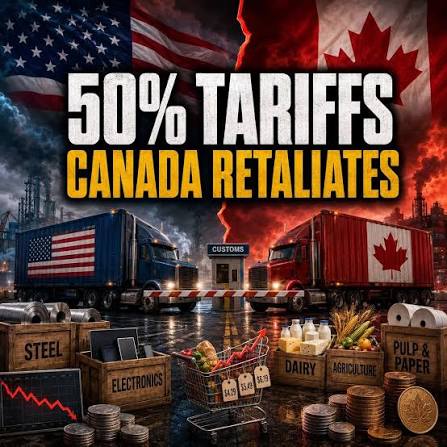
A 50% tariff is not a policy tweak. It is a price shock with a customs form.
Following reports that Washington imposed 50% tariffs on Canadian goods after trade talks collapsed, companies on both sides of the border are facing the kind of sudden cost reset that can move from loading docks to store shelves with startling speed. The U.S.–Canada trade relationship is not a narrow corridor of niche products; it is one of the world’s busiest commercial arteries, carrying crude oil, cars, auto parts, lumber, metals, fertilizer, food ingredients and consumer goods in both directions every day.
That is why this fight matters far beyond Detroit, Toronto or Calgary. A tariff of this size can scramble supply chains, push buyers into alternative markets, and raise benchmark prices for commodities that are traded globally. Even consumers who never knowingly buy a Canadian product could feel the aftershocks.
Why a 50% Tariff Hits Differently
Tariffs are taxes on imports, paid by importers at the border. In practice, those costs are divided among companies, suppliers and consumers depending on bargaining power, contracts and how quickly buyers can find substitutes. At 5% or 10%, firms may absorb part of the hit for a while. At 50%, absorption becomes much harder.
For many products moving under the U.S.–Mexico–Canada Agreement, the baseline expectation has been low- or zero-tariff trade if goods meet origin rules. A sudden 50% duty changes the math immediately. A $30,000 Canadian-made vehicle imported into the United States could face a tariff bill of $15,000 before dealer margins, financing costs or sales taxes. A lumber shipment priced at $600 per thousand board feet would suddenly carry an added $300 cost at the border.
Importers can delay shipments, renegotiate contracts or seek exclusions, but they cannot easily redesign supply chains overnight. The result is usually a messy mix: some orders are canceled, some prices rise, and some costs get buried in narrower margins until quarterly earnings force a reckoning.
The First Pressure Points: Autos, Energy, Lumber and Metals
The auto sector would be among the first to feel pain because North American vehicle production is deeply integrated. Parts routinely cross borders multiple times before a finished car reaches a showroom. Engines, transmissions, seats, electronics and stamped components can move between plants in Ontario, Michigan, Ohio, Kentucky and Mexico as part of one production system.
A broad tariff on Canadian goods would not only affect Canadian-built vehicles. It could raise costs for U.S.-assembled models that rely on Canadian parts. Automakers may respond by prioritizing higher-margin vehicles, delaying production of lower-margin models or passing costs to dealers. For consumers, that means fewer discounts, longer wait times and higher monthly payments.
Energy is another major flashpoint. Canada is the largest foreign supplier of crude oil to the United States, and many U.S. refineries—especially in the Midwest—are configured to process heavier Canadian crude. If tariffs apply to energy imports, refiners may face higher feedstock costs or be forced to source more expensive alternatives. That can show up in gasoline, diesel, jet fuel and heating oil markets, particularly in regions with fewer supply options.
Lumber would be next. Canadian softwood is central to U.S. homebuilding. A 50% tariff could push up costs for builders already dealing with high financing costs and affordability pressures. The impact would not stop at new homes. Renovation projects, furniture, pallets and packaging can all be affected when wood prices rise.
Metals matter too. Canada is a major supplier of aluminum to the United States, and aluminum is used in beverage cans, aircraft parts, vehicles, appliances, packaging and power infrastructure. A tariff-driven jump in aluminum input costs can ripple through everyday products quickly because the metal is embedded in so many manufacturing chains.
Groceries and Industrial Inputs Could Follow
The grocery aisle may not feel the first shock, but it rarely escapes a trade war. Canada supplies the United States with meat, grains, baked goods, frozen foods, canola oil, maple products and food ingredients used by processors. A tariff on finished food products can raise retail prices directly. A tariff on ingredients can raise them indirectly, when manufacturers adjust wholesale prices.
There is also fertilizer. Canada is a global heavyweight in potash, a key nutrient for crop production. If tariffs or retaliation disrupt fertilizer flows, farmers could face higher input costs. Those costs feed into planting decisions and, eventually, prices for corn, soybeans, wheat, meat and packaged foods. The lag can be months, but the channel is real.
Industrial buyers would face similar complications. Chemicals, plastics, paper, machinery and electrical equipment all move across the border in large volumes. Manufacturers that run lean inventories could be forced to choose between paying the tariff, slowing production or bidding against competitors for alternative supply. None of those options is cheap.
Why the Price Shock Could Go Global
The most common mistake in reading a U.S.–Canada tariff fight is assuming it stays bilateral. It does not.
Start with substitution. If U.S. buyers pull back from Canadian lumber, aluminum, crude or food inputs, they will look elsewhere: Europe, Latin America, Asia or domestic suppliers. That extra demand can lift prices in those markets. Meanwhile, Canadian exporters shut out of the U.S. market may redirect goods overseas, depressing prices in some regions while raising logistics costs and creating bottlenecks in ports and rail networks.
Then comes retaliation. If Canada responds with tariffs on U.S. goods, American exporters may lose sales and redirect products to other markets at discounts. That can unsettle global prices for agricultural goods, machinery, consumer products and energy-related equipment.
Currency markets can amplify the effect. A trade shock that weakens the Canadian dollar may make some Canadian exports cheaper globally, while making imported goods more expensive for Canadian consumers. A stronger U.S. dollar, if investors seek safety, can make dollar-priced commodities more expensive for emerging markets.
Finally, there is confidence. Businesses hate uncertainty more than almost anything. If executives begin to believe that North American trade rules can change abruptly, they may build larger inventories, diversify suppliers or move production. Those defensive moves raise costs. Over time, those costs become prices.
Who Pays—and How Fast?
Consumers do not always pay the full tariff immediately. Large retailers and manufacturers may use existing inventory, long-term contracts or currency hedges to slow the pass-through. Some suppliers may cut prices to preserve market share. Some importers may eat losses temporarily.
But a 50% tariff is large enough to break the usual buffers. Products with short inventory cycles—fuel, fresh food, construction materials and commodity-linked inputs—can reprice quickly. Big-ticket manufactured goods, such as vehicles and appliances, may move more slowly but can deliver a larger hit when price increases finally arrive.
The burden will be uneven. U.S. regions that rely heavily on Canadian energy, lumber or auto parts may feel more pain than coastal markets with easier access to global suppliers. Low-income households are more exposed because fuel, groceries and rent-related costs take a larger share of their budgets. Small businesses also have less leverage than multinational firms when negotiating with suppliers.
Conclusion: A Border Fight With Global Consequences
A 50% tariff on Canadian goods would be more than a diplomatic rupture. It would be a stress test for one of the world’s most integrated trade relationships.
The first shocks would likely hit autos, energy, lumber, metals and food inputs. The second wave would come through substitution, retaliation and higher supply-chain costs. The third would be psychological: companies rethinking whether North American trade is still predictable enough to plan around.
That is why consumers far from the U.S.–Canada border should pay attention. In a global economy, a tariff at one checkpoint can become a price increase almost anywhere.